



Faced with the impacts of modern life and increasingly powerful cultural interference, many traditional traits of the Phù Lá are at risk of disappearing, demanding timely solutions to preserve and promote the cultural values of this minority group.
The threat of disappearance
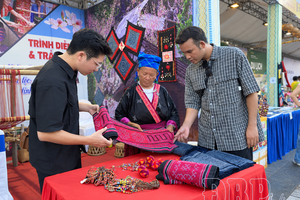
Kép village in Sáng Nhè commune is one of the few areas where the Phù Lá community lives in a concentrated manner, with 10 households and 48 people. The village nestles against the mountainside, with winding roads leading past sprawling corn and cassava fields. Tin-roofed houses mixed with traditional wooden structures create the familiar appearance of a highland village. From ancient times, Phù Lá women here have known how to spin thread, weave cloth, and embroider to hand-make their traditional costumes. These garments demonstrate the skill of the women while reflecting the laboring life and religious beliefs of the community. Every pattern and every stitch carries its own meaning, contributing to the characteristic cultural identity of the Phù Lá people.
However, according to Quàng Văn Viện, the Party Secretary of Kép village, there was a time when traditional costumes gradually faded from daily life. Residents shifted to using more convenient ready-made clothing. The looms that once hummed with the sound of shuttles sat silent in the corners of homes, and the number of people who knew how to embroider and sew traditional attire dwindled, consisting primarily of the elderly. Quàng Văn Viện shared that there were moments it seemed the ethnic costume would vanish entirely, as the youth were no longer interested and the elders became fewer, unable to pass the tradition down to their descendants.
.jpg)
Statistics show that by the end of 2025, the entire province of Điện Biên had only 198 Phù Lá people, living mainly in Sáng Nhè and Pú Nhung communes. With such a small population size and living among other ethnic groups like the Mông, Thái, and Dao, Phù Lá culture has been heavily influenced. Beyond costumes, many traditional customs, habits, and rituals are gradually being lost. In wedding ceremonies, funerals, or festivals, many traditional elements have been simplified or replaced, and attire has even taken on influences from neighboring groups. Furthermore, inter-ethnic marriage makes maintaining specific customs difficult.
The teaching of Phù Lá culture within the community is becoming increasingly limited. Artisans who hold and understand traditional culture are growing older, while the younger generation is exposed to many new cultural streams and shows little interest in traditional customs. Many young people leave the village to work far away and rarely participate in community activities. Those evenings gathered around the hearth, where elders told stories, taught embroidery, or sang folk songs, are becoming scarce. Consequently, the gap between generations in receiving and preserving culture is widening.
Trần Ngọc Duyên, Vice Chairman of the Sáng Nhè commune People’s Committee, noted that the Phù Lá have rich customs and rituals linked to production and beliefs, such as the New Rice celebration, the field-going ceremony, forest worship, and especially the “Village Sweeping” ritual. Currently, many of these rituals are not performed in their entirety, and the risk of them being lost forever is very high without timely conservation solutions.
Reviving traditional values
After many years of hardly touching a needle and thread, Lý Thị Thương, a Phù Lá woman in Túc village, Sáng Nhè commune, has begun to sit back at her fabric frame to meticulously embroider traditional patterns. Though her initial stitches were slow and uneven, they have gradually become more confident. This change stemmed from her participation in dissemination sessions and workshops regarding intangible cultural heritage organized by the cultural sector and local authorities. Having gained a clearer understanding of the significance of traditional attire, Lý Thị Thương has proactively taken up sewing and embroidery, viewing it as a way to restore traditional crafts and preserve her ethnic identity.
Faced with the risk of losing many Phù Lá traditional values, various levels of government and sectors have implemented numerous solutions. Recently, the Department of Ethnic Culture of Vietnam collaborated with the Điện Biên provincial Department of Culture, Sports and Tourism and the Sáng Nhè commune People’s Committee to organize activities for the research, restoration, preservation, and promotion of the Phù Lá “Village Sweeping” ritual. During these activities, the community atmosphere became more vibrant as elders directly taught the younger generation each rite, prayer, and way of preparing offerings. Students learned the theory and participated in practice, recreating the ritual within the cultural space of their own village.
Quàng Văn Viên, a resident of Kép village, stated that he previously only had a superficial understanding of the “Village Sweeping” ritual, but after participating in the class, he understood its meaning and procedures much more clearly. More importantly, he felt a great sense of pride in his ethnic culture and now wishes to preserve and pass it on to his children. These conservation activities have contributed to changing community awareness. In villages where the Phù Lá live, many women have returned to embroidery and weaving, children have become familiar with ethnic costumes during festivals and holidays, and community activities are maintained more regularly.
On a broader scale, Điện Biên province is actively implementing content under the National Target Program for the socio-economic development of ethnic minority and mountainous areas. Specifically, Project 6, which focuses on “Preserving and promoting cultural values associated with tourism development,” is being prioritized, opening a new direction in combining cultural conservation with economic growth. To ensure that Phù Lá traditional cultural values are preserved sustainably, the key factor remains the people themselves, the subjects of the heritage. When every citizen understands their ethnic cultural values and feels proud and proactive in preserving them, beautiful traditional traits will continue to be passed down through generations. While the journey to “revive” Phù Lá traditional culture remains arduous, the attention of government levels and the shift in community awareness offer hope that these precious values will be preserved and promoted, enriching the diverse cultural identity of the ethnic communities in Điện Biên.
Minh Thảo
.jpg)
.jpg)
.jpg)
.jpg)
.jpg)
.jpg)
.jpg)

.jpg)
.jpg)
.jpg)
You have 500/500 characters left
Please enter 5 or more characters!!!